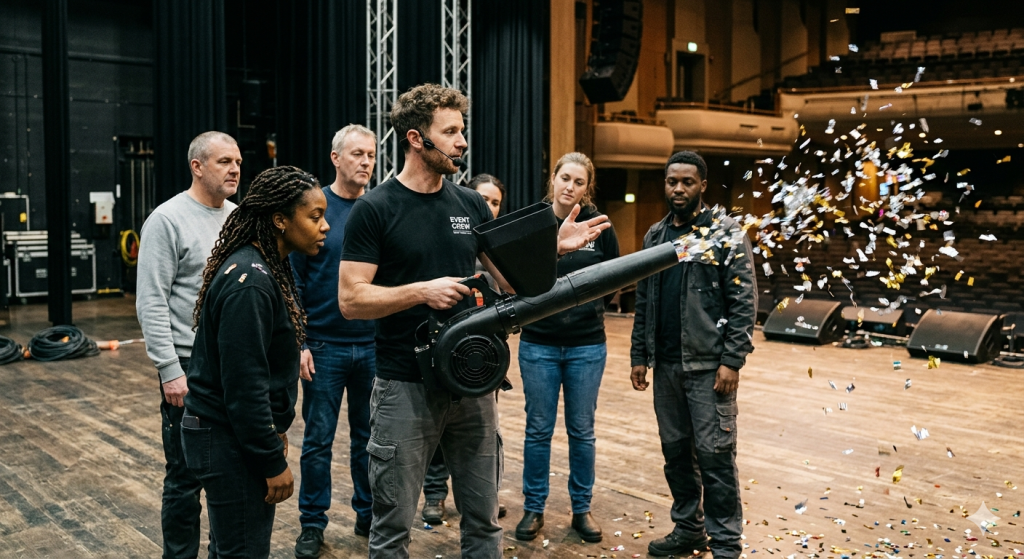
You’ve already decided on the machine. Now you need to know how to actually use it so the moment lands the way you pictured it. That’s what this guide is for.
Most confetti machine mishaps we hear about aren’t equipment failures. They’re setup errors: a chamber loaded too full, a machine aimed at the wrong angle for the room, a blast fired half a beat too late. None of those are hard to avoid once you know what to do. Here’s everything we’ve learned from customers who’ve run our machines across weddings, corporate events, gender reveals, and everything in between.
Before the Event: The Setup Decisions That Determine Everything
Read your venue before you read your machine
Ceiling height, room shape, and air conditioning all change how confetti travels from an electric confetti machine. A 30-foot blast in a low-ceiling banquet hall behaves completely differently from the same machine in an open-sided marquee tent. Before you finalize your position or angle, walk the venue and look at three things:
- Ceiling height: lower ceilings mean confetti peaks earlier and falls faster. Adjust your angle toward horizontal to extend range.
- Air flow: air conditioning vents above the blast zone will carry confetti off-course. Identify where the airflow goes and position accordingly.
- Room shape: a narrow room concentrates the burst well from one end. A wide room needs either a central position angled upward or two machines at opposing corners.
None of this replaces a test blast. But thinking through the space before you set up means your test blast confirms rather than surprises.
Do a test blast before guests arrive
This is non-negotiable. Run one full blast at the actual venue, at the actual angle you plan to use, before anyone arrives. Watch where the confetti travels, where it lands, and whether it fills the space the way you intended. Adjust the angle, reload, and test once more if needed.
Event planners who use our machine regularly tell us the test blast is the most valuable five minutes in their setup process. It costs one chamber load of confetti and saves the actual moment from being used as a test.
How to Load a Confetti Blower Machine Correctly
Fill to 80 percent, not full
This is the single most consistent tip we pass on from planners who’ve run our electric confetti machine across dozens of events. Loading the chamber to about 80 percent capacity produces a stronger, more even blast than filling it completely.
A full chamber packs confetti tightly against the fan intake, which restricts airflow and weakens output. At 80 percent, the motor moves air freely through the confetti, and the density and range of the blast are both noticeably better. Counter-intuitive, but consistent across every venue and confetti type we’ve tested.
Use the right confetti for machine use
Not all confetti is cut for airflow. Small circles and rectangles roughly 1.5 cm across flow through the nozzle cleanly, disperse evenly in the air, and don’t clump in humid conditions. Larger shapes, foil-heavy mixes, and thick cardstock can restrict the nozzle and reduce range.
All of our biodegradable tissue confetti is cut specifically for machine use. If you’re using confetti from another source in our machine, test it before the event. A clog during a first dance is not a situation you want to troubleshoot in real time.
Reload between moments without rushing
Our machine reloads quickly, but give yourself a buffer between confetti moments if you’re running more than one. At events with a ceremony blast, a first dance blast, and a send-off, the planner should reload immediately after each firing rather than waiting until the next moment approaches. Rushed reloading leads to overfilled chambers, which leads to weaker blasts.
How to Position Your Electric Confetti Machine for Maximum Effect
The best placement for a confetti machine is wherever it creates the most visual impact, not wherever the power outlet happens to be. Extension cords are your best friend on event day. Use them.
Angled straight up: the ceiling-fall effect
Position the machine centrally and angle the nozzle straight up. Confetti launches high, peaks at or near the ceiling, and drifts slowly down across the crowd. This creates the most cinematic effect: a wide, even coverage area with confetti in the air for several seconds. Best for large rooms with ceiling height of 14 feet or more.
Angled forward: the crowd-facing burst
Elevate the machine slightly (on a table, a riser, or a stand) and aim it directly at the crowd. This delivers a wall of confetti moving toward guests rather than falling on them. It’s more dramatic and immediate than the ceiling-fall effect, and it reads as a single directional burst on camera. Best for narrower rooms, stage moments, or anywhere you want the confetti to come at guests rather than over them.
Angled at 45 degrees from a corner: the widest room coverage
Position the machine in a back corner of the room, angled at roughly 45 degrees toward the center. This gives you the widest diagonal scatter from a single unit and covers more floor area than a straight-ahead blast from the same position. Best for square or near-square rooms where a central position isn’t available.
Two machines for large or wide spaces
For venues over 2,000 sq ft or rooms wider than 40 feet, a single machine positioned centrally will cover the center of the space well but leave the edges thin. Two machines placed at opposite ends or opposite corners, fired simultaneously via separate wireless remotes, creates even coverage across the full room. This is the setup most professional planners use for weddings and large corporate events.
How to Time Your Confetti Blast
Timing is the difference between a confetti moment that lands and one that’s remembered as “that bit where the confetti went off.” Here’s how to get it right.
Assign one person to the remote
The remote should be in the hands of whoever is closest to the moment: the MC, the planner, the DJ, or a designated coordinator. It should not be passed around, forgotten on a table, or operated by someone who doesn’t know the cue. Confirm who holds the remote before the event starts and brief them specifically on the trigger point.
Fire just before the peak, not at it
The instinct is to fire at the highest point of the moment: the last note of the song, the word “married,” the stroke of midnight. But confetti takes one to two seconds to fill the air after the blast. If you fire at the peak, the burst hits while the moment has already passed.
Fire just as energy in the room is rising. The confetti reaches its fullest spread exactly when the moment crests, and that’s the window every camera in the room is pointed at.
Coordinate with your photographer
Tell your photographer or videographer exactly when the blast is happening and from which direction the confetti will travel. A photographer who’s caught off-guard by the blast will be adjusting settings when the best shot is in the air. A photographer who’s ready will be in position, focused, and shooting before the confetti peaks.
For events with a professional photographer, a quick test blast during setup, at the same angle and position as the real moment, lets them calibrate exposure and position before guests arrive.
Getting the Best Confetti Photos and Video
The machine moment is only as good as what the camera catches. A few things make a consistent difference.
Light direction matters more than quantity
Confetti photographs best when light hits it from behind or from the side rather than straight on. Backlit confetti, particularly metallic sparkle cuts, creates a prismatic effect where individual pieces catch and scatter light in multiple directions. Front-lit confetti reads flat. If you have any control over where the machine is positioned relative to windows, uplighters, or stage lighting, put light behind or beside the burst, not in front of it.
Burst mode catches what single shots miss
A confetti blast lasts two to four seconds at its fullest. A single shutter press will capture one frame of that window. Burst mode captures the whole arc of the moment and gives you a sequence to choose from. Brief your photographer on this if they’re not already planning for it.
Dark backgrounds make color read harder on camera
Confetti color pops most against dark backgrounds: evening venues, dark feature walls, dark clothing. In brightly lit spaces with white or pale walls, confetti can wash out in photos. If your venue is bright and pale, metallic sparkle confetti reads better than matte tissue because the reflective surface registers regardless of background.
After the Event: Cleanup by Confetti Type
Biodegradable tissue paper confetti
Vacuums up cleanly with a standard vacuum on normal suction. Doesn’t embed in carpet or fabric the way foil does. For outdoor events, tissue paper breaks down naturally within weeks and doesn’t require active cleanup beyond a quick sweep or rake of the immediate area.
Metallic or sparkle confetti
Pick up the bulk by hand or with a lint roller on fabric surfaces before vacuuming. Fine metallic pieces can embed in carpet pile if vacuumed directly without removing the surface layer first. On hard floors, a soft broom collects it more effectively than a vacuum on the first pass.
Venues with cleanup fees
Most venue cleanup concerns involve foil confetti on carpet or upholstery. Our biodegradable tissue paper confetti is the type that generates the least friction with venue coordinators. If your venue has a cleanup policy or a specific confetti approval process, reach out to us before your event and we’ll confirm which products are cleared and provide any documentation they need.
A Quick-Reference Checklist for Event Day
Before guests arrive:
- Walk the venue and assess ceiling height, airflow, and room shape
- Position the machine and run a test blast at the planned angle
- Load the chamber to 80 percent capacity
- Confirm the wireless remote is working and in the right hands
- Brief the photographer on blast timing and direction
- Reload immediately after each test blast
During the event:
- Fire just before the moment peaks, not at it
- Reload immediately after each blast if you have a second moment coming
- Keep the remote with the designated person at all times
After the event:
- Collect tissue paper confetti with a standard vacuum
- Remove surface metallic confetti by hand before vacuuming
- Confirm with the venue that the space meets their cleanup standard
Ready to Set Up Your Machine?
If you’re still deciding which machine or cannon is right for your event, our confetti machine gun buying guide covers every product type, venue size recommendation, and buying criteria in detail.
If you’re ready to shop, browse our full range of electric confetti machines, confetti cannons, and biodegradable confetti at Uniconfetti. Every product ships with setup guidance and our 100%.